
Tradition · science
The astrolabe: Moroccan instruments for reading the sky
An astrolabe is a brass instrument that models the sky. With it you can tell the time from the sun or the stars, measure the height of a star and work out when it will rise. For centuries, Moroccan scholars and craftsmen made and used them.
Published

How it works
A flat plate engraved with a projection of the sky sits under a pierced disc, the rete, whose pointers mark bright stars. By sighting the sun or a star along a rotating bar on the back and turning the rete to match, the user reads off the time and other values. One instrument replaced pages of calculation.
Timekeepers in the mosque
In Morocco astronomy had a daily use: setting the times of prayer. From the Marinid period onward, many mosques had a dar al-muwaqqit, a room for the timekeeper, who worked with astrolabes, sundials and water clocks. At the Qarawiyyin in Fes, the scholar Abd al-Rahman al-Jadiri served as timekeeper in the early 15th century.
Moroccan makers
Astrolabes were still made in Morocco well into the 19th century, long after they had fallen out of use in Europe. Museums such as the History of Science Museum in Oxford hold Moroccan examples, including a brass astrolabe made in 1733–34 by Muhammad ibn Ahmad al-Battuti.
From astrolabe to navigation
The GPS Said No design reimagines a brass astrolabe as a travel-navigation device: a historic instrument for finding your way by the sky, for the days when modern directions say no and you go anyway.
Sources
More from Morocco
 Tradition · leather
The tanneries of Fes and Moroccan leather
How hides are tanned and dyed in the stone vats of Fes, what Moroccan leather becomes — babouches, bags, poufs — and how to visit the tanneries.
Read ↗ Tradition · dress
The fez: the red hat named after a Moroccan city
Where the fez hat comes from, why it is linked to the city of Fes, how it spread through the Ottoman world, and when it is worn in Morocco today.
Read ↗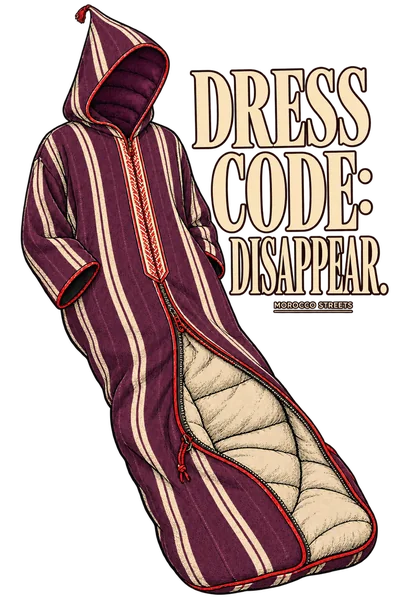 Tradition · dress
The djellaba: Morocco’s hooded robe
What a djellaba is, what its pointed hood is for, the fabrics for summer and winter, and how men and women wear it today.
Read ↗